Avatar Chris can’t organise a village fête

Someone had to say something.

There we are, having a good ole friendly chat at the Winston when this Chris guy starts talking about some formal occasion he’s organising. Nice one, right?

Wrong. He’s got it all wrong. What should be an easy win with an open goal turns into an own goal which smells of bad eggs and then renames all the roads in England and Wales without telling him, and they’re super silly names too that you’ll never remember.

I get the impression he’s never been to a village fête, let alone sorted one out. Here’s all the information we have so far:

What he does have:

  • A carousel
  • A big event (possibly involving cars)
  • Everyone turning up in formal dress

What he doesn’t have:

  • A craft tent full of bickering old ladies
  • A white elephant stall selling all the piddling crap people got for Christmas that were too embarrassed to drop off at a charity shop
  • A man with a laser who loves lasering names into pieces of wood, metal and any other material that’s safe for his laser
  • Whack-a-rat (sometimes known as ‘Splat the rat’)
  • A cake stall where someone has mislabelled the prices so a full fruitcake is 99p but a single scone is £4.99
  • An announcer who is so muffled by feedback nobody can tell what he or she is saying
  • Terrible weather halfway through that clears up after 8 minutes, giving all the old people something to talk about for the rest of the afternoon

As you can see, there’s a lot of work that needs doing in a very short period of time. I’m also sure I’ve missed a few obvious ones there.

I would recommend the services of Kevin “been doing this 30 years, bruh” Hill because he’s been, well, you probably get the jist. The experience and expertise he can bring will be invaluable and will ensure that Chris and his village fête are quintessentially perfect in the eyes of everyone who attends. The eyes are all that matter.

I’ll bring a bag of pennies and the overwhelming optimism of a man who hasn’t watched the news for two decades.

Avatar We are all last minuters

You run a remarkably successful (?) website. You need to come up with content every single month to entertain the millions (?) of punters who keep turning up for laughs (?).

Okay, I’ll stop there.

If you ever needed proof that despite our best intentions, we all normally earn a bean by scraping something up on the last day of the month then here it is:

I did a screenshot with an even longer list but I think I may have deleted it and/or it got lost in the hundreds of baby orb photos I’ve taken since September.

Hey, we’re all human. Coming up with new and entertaining ideas is hard when you lead such busy lifestyles such as ourselves. I’m not going to beat myself up over something as trivial as this. I’m going to listen to the weird whistling sound the radiator in the dining room makes now that we’ve had a new boiler installed and smile.

Avatar Guide to the Genus Melocaeruledus: The Cave Fladger

2025 is almost done, and what better way to wecome in 2026 than with another terrifying creature? Yes, youve guessed it, its fladger time again! This time we head underground in search of one of the most unique melocaeruledi, the Cave Fladger…

Cave Fladger

Scientific Name: Melocaeruledus troglolucens (troglo = of caves, lucens = glowing or shining)

Common Names: The Cave Fladger, Ghost Fladger, Damp Gimp Wasp

Habitat: Limestone caves, subterranean rivers.

Description: The pallid, almost glassy skin of the Cave Fladger reveals an intricate network of grey veins. It appears to glow when hit with torchlight. Its huge, sensitive ears allow audible nagivation, granting it almost silent flight in utter darkness. The Cave Fladger’s diet consists chiefly of beetles, moths, and blind cave shrimp

Behaviour: The Cave Fladger is mostly timid in nature, and will try its best to hide from humans who find thier nests. They have been known to work as a pack in defence of thier homes or young, emmitting a high pitched squeel, similar to that of a human baby, to gather support from others.

Notes: Legends claim their appearance can predict misfortune, though this may be attributed to startled cavers falling to their demise upon being greeted by a pack of screaming translucent gimp wasps.

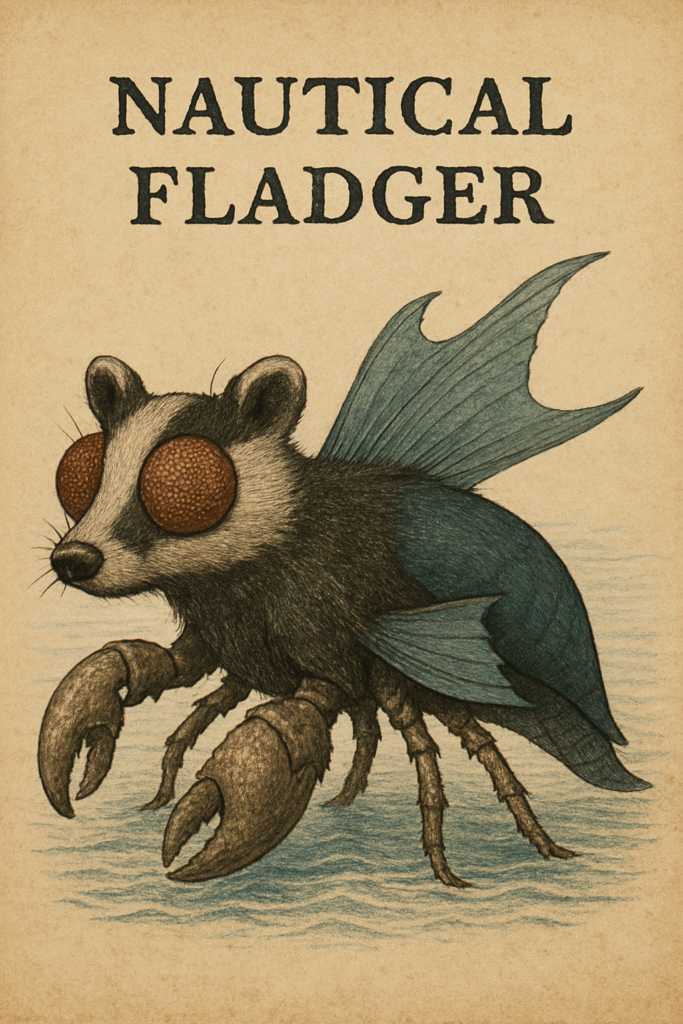
Avatar Guide to the Genus Melocaeruledus: The Nautical Fladger

Welcome back to the Melocaeruledus zone. This time we take a deep dive (literally) into the aquatic regions of the Fladger family tree with the Nautical Fladger…

Nautical Fladger

Scientific Name: Melocaeruledus pelagornis (pelagornis = “of the open sea”, befitting its aquatic and wide ranging habitats)
Common Names: The Nautical Fladger, The Sea Bastard, The Pinchy Fizzer.

Habitat: Rocky shores, tidal caves, open seas.

Description: This maritime variant retains the shimmering blue-green fly arse of its kin, but its forelegs have evolved into lobster-like claws suited for cracking shellfish and prising molluscs from rocks. Its wings, encrusted with salt, serve as stabilisers in water as well as for brief buzzing flights between tidal pools, reefs and stranded boats.

Behaviour: It is fiercely territorial around rich feeding grounds and is known to follow fishing vessels, stealing bait and offal when it thinks nobody is looking. When threatened, it retreats to coastal caves, clinging upside-down to damp stone while emitting a low, rattling buzz to ward off intruders.

Notes: The Nautical Fladger is more often heard than seen—its eerie trilling cry echoing across misty harbours.

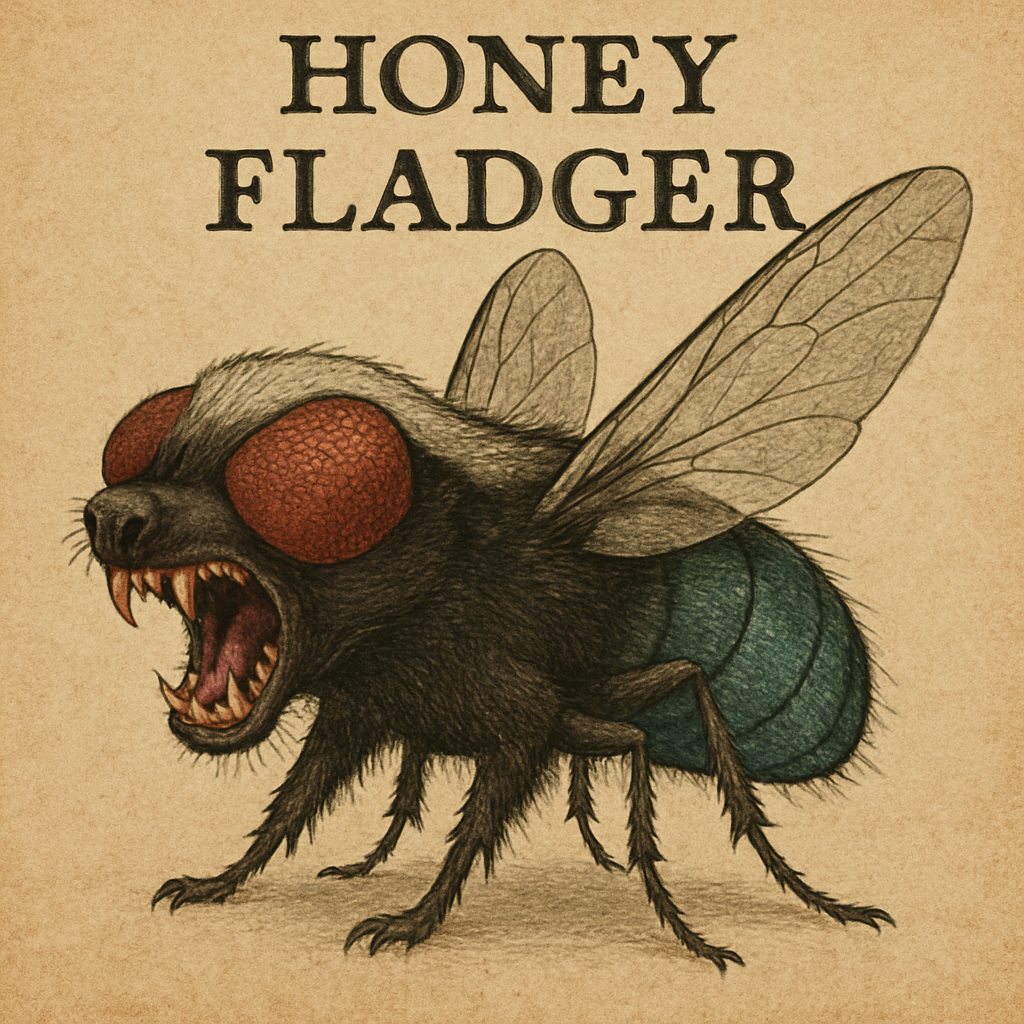
Avatar Guide to the Genus Melocaeruledus: The Honey Fladger

Welcome back to Melocaeruledus corner. This week we take a deep dive into the scarier parts of the Fladger family tree with the Honey Fladger…

Honey Fladger

Scientific Name: Melocaeruledus melliferus (melliferus = “honey-bearing”, fitting its honey badger heritage and predatory, aggressive nature.)
Common Names: The Honey Badger,

Habitat: Savannah, scrublands, arid grasslands.

Description: The Honey Fladger combines the white-headed bastardry of the honey badger (Mellivora capensis) with the shiney blue abdomen of a bluebottle fly. Compound eyes lend it a fearsome viso/volto.

Behaviour: Both feared and admired by locals, Its powerful build makes it a fearless hive-raider. Shrugging off bee stings, it consumes the honey, wax, and larvae with equal relish. Whilst it will generally eat anything that annoys it, it has a fondness for snakes, biting them behind the head and dropping them from a great hight onto other unsuspecting Honey Fladgers.

Notes: Its buzzing flight has been likened to the growl of a wolverine caught in a trap.

Avatar Newsboost – Burnham’s Laburnums

Burnham Calls for Change in Laburnum Society

Greater Manchester Mayor Andy Burnham has turned his attention from politics to petals, declaring that his laburnums outshine those grown in London, and that he should take the helm of the Laburnum Society.

Speaking at a small community garden event this week, Burnham praised his golden-flowering trees, saying, “I honestly believe the laburnums I grow here are stronger, brighter, and more accessible than anything they’ve got down south. The Laburnum Society is not currently serious about serving the people. I’ve even had Laburnum Society Committee members asking me to stand for the leadership now”

Burnham went on to argue that laburnums should not remain the preserve of the wealthy or well-connected. “These flowers should be available to everyone, regardless of cost,” he said. “We need to make them a part of everyday life, not just something admired in gated gardens or exclusive shows.”

While his comments have raised eyebrows among traditionalists in the horticultural world, local gardeners in Manchester have welcomed Burnham’s push for a more open and inclusive approach to laburnum growing.

The Laburnum Society has yet to respond to his remarks.

Avatar Guide to the Genus Melocaeruledus: The Fladger

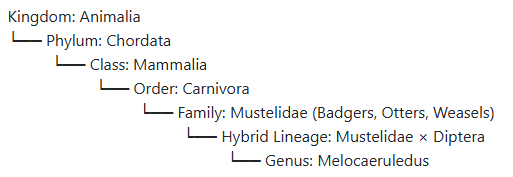
Welcome to this, the first in a series of informative articles which explore the mysterious, often erroneously thought to be mythical, genus of animals, the Melocaeruledus.

As I’m sure you’re no doubt aware the name Melocaeruledus comes from the latin, Melo from “meles”, relating to a badger and the suffix caeruledus suggests a blue hue.

We will start our series exploring the most famous and most commonly seen member of the genus, the Melocaeruledus melesvolans

Read More: Guide to the Genus Melocaeruledus: The Fladger »